





























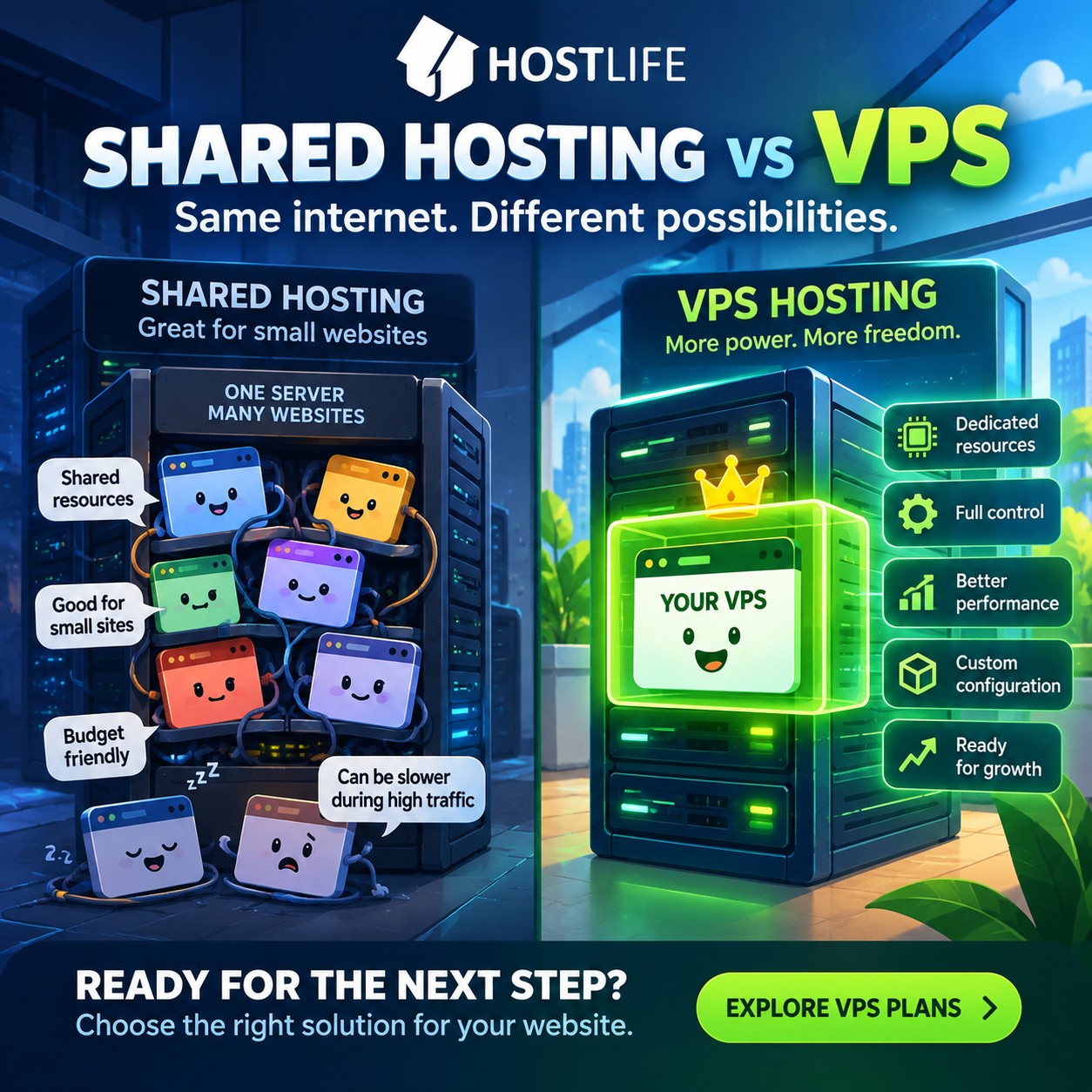
Regular shared hosting is an excellent choice for most small websites. You don't need to worry about server configuration, updates, or administration — everything you need is already up and running.
But websites grow: visitor numbers increase, resource-intensive CMS platforms appear, online stores are added, and background tasks and databases become more demanding. At some point, the question arises: is it time to switch to a VPS?
Regular hosting — when is it enough?
If you have a corporate website, a blog, a small WordPress site, or a landing page, switching to a VPS just "because it's more advanced" usually makes little sense.
For these projects, regular shared hosting may be perfectly suitable. If your website uses more resources or requires a higher-performance configuration, consider Premium Hosting.
For websites built on popular CMS platforms, there is also specialized CMS Hosting.
With regular hosting, you get a ready-to-use environment, while the hosting provider takes care of the technical tasks.
Fewer settings — less hassle.
What changes with a VPS?
A VPS is a virtual server with its own operating environment and dedicated resources.
You get greater control over:
- CPU;
- RAM;
- disk space;
- software environment;
- web server configuration;
- databases;
- additional services.
This is particularly useful when your website has outgrown the capabilities of standard hosting.
If you're moving to a VPS for the first time, Essential VPS may be a sensible option — the next step after regular hosting without having to choose a powerful server right away.
But a VPS isn't always faster
This is important to understand: switching to a VPS does not automatically make your website faster.
A poorly configured VPS can easily perform worse than well-configured shared hosting.
Speed depends on the CPU, RAM, storage type, web server configuration, database, CMS, caching, and, of course, the website's own code.
Therefore, a VPS is primarily about control and scalability, not a magic "make my website faster" button.
When do you really need a VPS?
Your website regularly hits hosting limits.
Resources are no longer sufficient, errors appear, or performance starts to drop.
You need a specific configuration.
You require a particular PHP version, Docker, additional services, or non-standard settings.
Your project has grown significantly.
An online store, portal, application, or another project now requires its own server environment.
Depending on your project's requirements, you can choose Standard VPS or the more powerful Performance VPS.
You need more control.
You want to manage the server environment and settings yourself.
When should you avoid buying a VPS?
If your website runs smoothly on regular hosting, traffic is modest, and there are no special requirements, there's no need to make things more complicated.
Good shared hosting can be a more convenient and cost-effective solution.
A VPS is the next step, not a mandatory stage
The right choice depends not on whether "a VPS is better than hosting," but on the specific needs of your project.
For a small website, straightforward shared hosting is usually the more sensible choice.
If your project uses a CMS and requires an environment better suited to it, consider CMS Hosting.
For more demanding websites, there is Premium Hosting, while projects that need their own server can choose from the VPS range, from Essential to Standard and Performance.
The key is to choose a server based on your project's actual requirements, not simply on the number of gigabytes included in the plan.