
























Today, HTTPS has become the standard for virtually every website. It relies on an SSL/TLS certificate.
But this raises a perfectly reasonable question:
If Let's Encrypt issues certificates for free, why pay for an SSL certificate?
At first glance, it seems that a free certificate does the same thing as a paid one. And in one important respect, that is indeed true.
However, there is a difference between certificates — it is simply not where many people expect to find it.
Free Let's Encrypt certificates are genuine SSL certificates
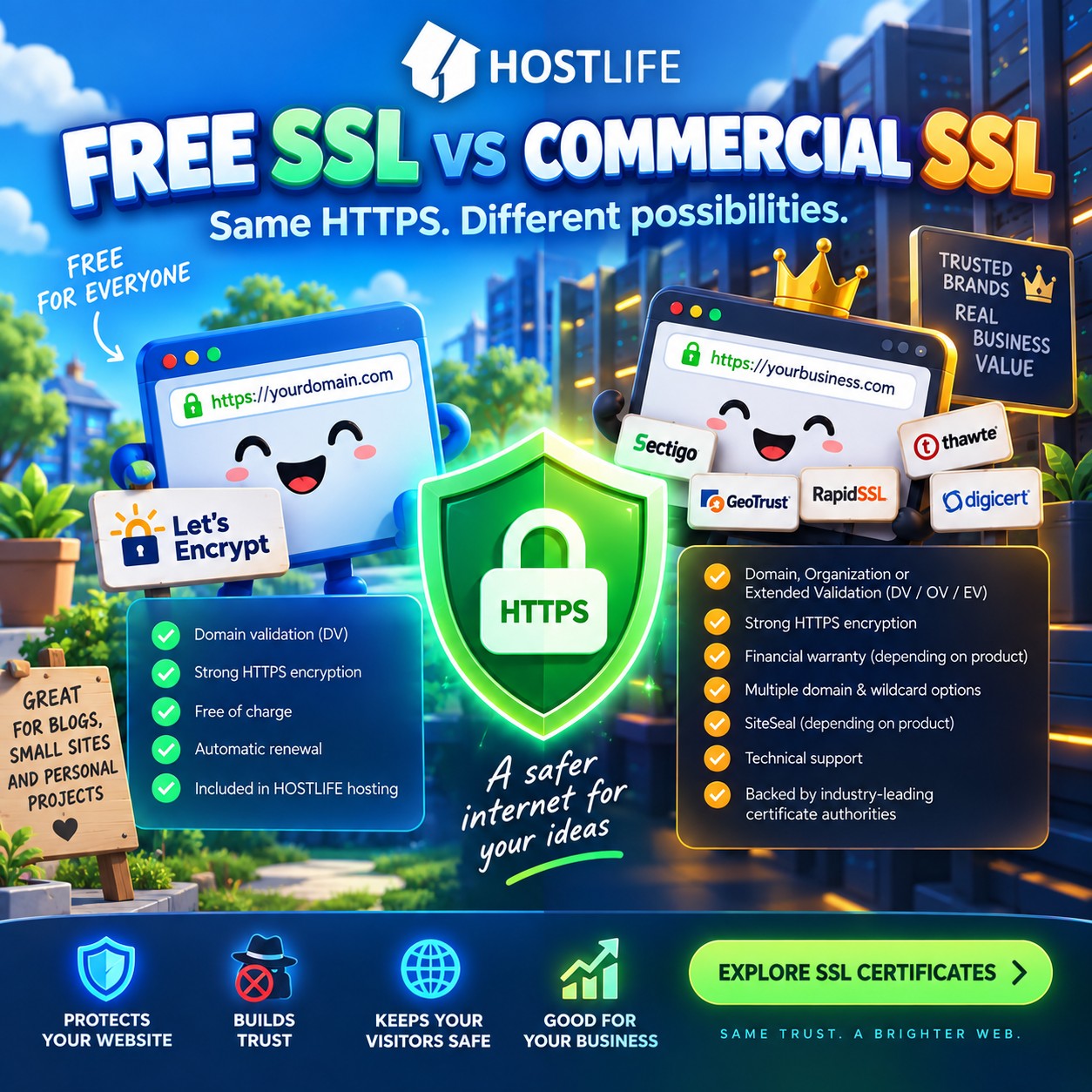
Let's Encrypt is a global certificate authority that issues SSL/TLS certificates with Domain Validation (DV — Domain Validation) free of charge. These certificates are used to secure websites over HTTPS.
A free certificate is not a "demo version of SSL."
It provides a secure TLS connection between a visitor's browser and the website.
That is why Let's Encrypt is an excellent choice for a huge range of projects: blogs, personal websites, small businesses, informational resources, and many online stores.
On HOSTLIFE hosting, Let's Encrypt certificates can renew automatically, so website owners do not have to install a new certificate manually every time.
So why do paid SSL certificates exist?
This is where things get interesting.
Paid SSL is not simply "the same HTTPS, but for a fee."
Depending on the specific product, a commercial certificate may offer additional features:
- validation of the organization, not just the domain;
- certificates covering multiple domains;
- Wildcard certificates for subdomains;
- extended validation;
- SiteSeal;
- technical support;
- a financial warranty subject to the terms of the specific product.
However, it is important to understand that a paid certificate does not automatically mean stronger encryption.
The difference between DV, OV, and EV primarily concerns what information the certificate authority verifies, rather than how much "stronger" the connection is encrypted.
DV, OV, and EV — what is the difference?
DV — Domain Validation
Control over the domain is verified.
This is the validation level used by Let's Encrypt.
For most standard websites, this is more than sufficient.
OV — Organization Validation
In addition to the domain, the certificate authority verifies information about the organization.
This matters for companies that need to verify their identity as the website owner.
EV — Extended Validation
This involves a more extensive verification of the organization in accordance with the requirements for EV certificates.
It is an option for projects that genuinely require this level of identity verification.
However, the old assumption that EV automatically gives a website a special "green address bar" in the browser is no longer valid today.
What about the warranty?
This is one of the differences between commercial certificates that can genuinely matter.
Some paid SSL certificates include a financial warranty. Its amount and terms depend on the specific certificate.
The HOSTLIFE catalog lists warranties ranging from $10,000 to $1,750,000 for different products. The terms depend on the specific certificate.
Let's Encrypt does not provide the same financial liability to users: ISRG explicitly states limitations on its liability for potential losses in its certificate terms of use.
But there is an important nuance:
A warranty is not insurance against website hacking.
It does not mean that a website owner will automatically receive the stated amount in the event of any data breach.
The grounds for a payout, limitations, and other conditions are determined by the policies of the relevant certificate authority and the specific certificate.
That is why, when choosing a paid SSL certificate, you should look beyond the product name and price and review its terms as well.
Commercial SSL certificates are backed by well-known certificate authorities
There is another aspect that often goes unnoticed.
When you purchase commercial SSL, you are choosing not just a certificate, but a specific product from a particular certificate authority.
The HOSTLIFE SSL Certificate Catalog features products from:
Sectigo · RapidSSL · Thawte · GeoTrust · DigiCert
These are well-known participants in the public certificate market, operating under industry requirements for certificate authorities. Public CAs undergo independent audits and must comply with established rules for issuing and managing certificates.
Different products therefore vary in their validation procedures, supported use cases, number of domains, Wildcard/SAN capabilities, SiteSeal, warranty terms, and technical support.
That is why commercial SSL is not simply a "paid version of Let's Encrypt."
So, is it worth paying for SSL?
Not necessarily.
If you have a blog, a personal website, a small informational project, or a standard corporate website, free Let's Encrypt will be sufficient in many cases.
However, if your project requires:
- organization validation;
- protection for multiple domains;
- Wildcard certificates;
- additional commercial features;
- technical support;
- a financial warranty;
- a specific commercial product or certificate authority,
then a paid SSL certificate may be worth the investment.
That is why HOSTLIFE offers both options.
Let's Encrypt — when you need a simple, free way to secure HTTPS.
Commercial SSL — when your project requires additional features, organization validation, or the specific terms of a paid certificate.
The bottom line
A paid SSL certificate does not automatically mean stronger encryption.
And Let's Encrypt is not an inferior SSL certificate.
The main differences lie in the level of validation, the features of the specific product, support, and liability terms.
Therefore, you should choose a certificate based on your project's requirements, not on the assumption that "more expensive means more secure."